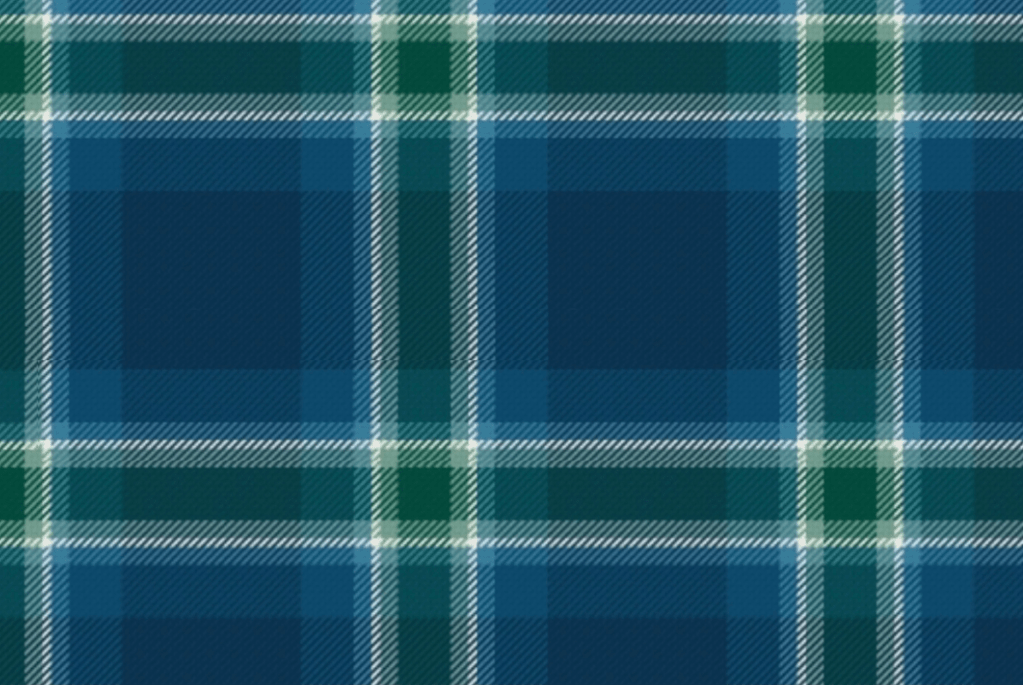
In 2021, on the way to leading a team of observers and advocates taking part in the COP26 United Nations Climate Change Conference in Glasgow, I created the Blue Planet tartan. The purpose was fourfold:
- To commemorate the work of non-governmental observers and stakeholders;
- to honor the host country, where I personally, and others on our team, have ancestry;
- to highlight the interwoven dynamics of the natural world;
- to stand as an ongoing reminder that all of Nature matters for human wellbeing.
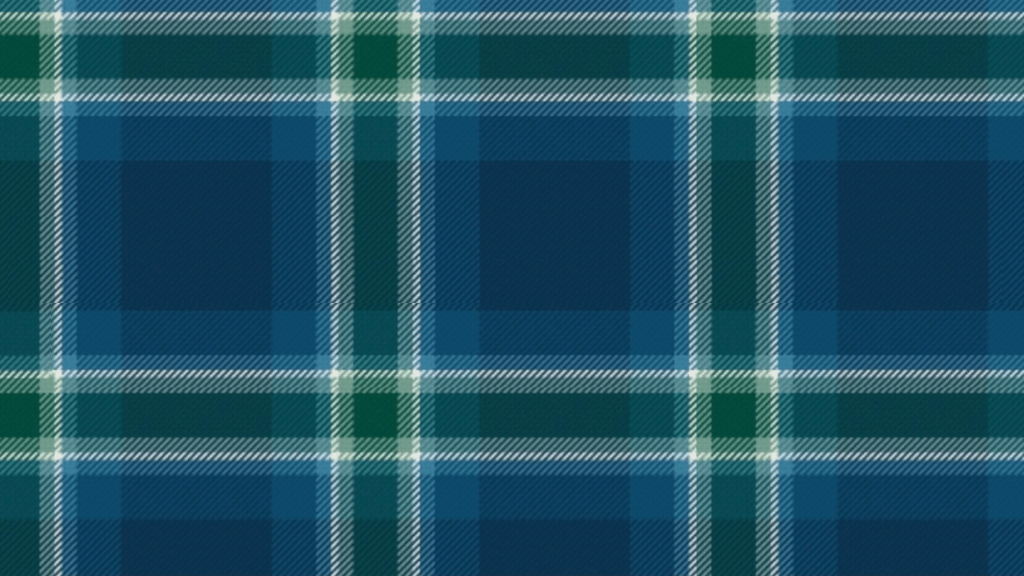
The tartan evokes planetary systems and our responsibility to act as responsible stewards:
- Deep blue anchors the design, representing the ocean—which for billions of years has made our planet hospitable to life.
- Medium blues at edges represent watersheds.
- The lightest blue color represents the atmosphere.
- Green squares and rectangles represent arable land, forests, and ecosystems.
- White is the cryosphere—the thin, icy layer of climate control, often far away from our thoughts—anchoring a stable climate that provides sustenance and wellbeing across the blue and green spaces of the biosphere.
- The human relationship with Nature is implicit throughout, both in the design interweaving planetary systems and in the conscious awareness that science draws clear evidentiary connections between human activity and the life of those planetary systems.
In 2026, it feels useful to revive the tartan and its enduring message. Climate disruption has worsened, major anchor ecosystems are at risk, ocean currents critical to planetary health and climate stability are projected to be on their way to collapse, and food security is increasingly vulnerable to shock events and compounding risks.
The climate, Nature, biodiversity, and the health and resilience of ecosystems, watersheds, and the cryosphere—however distant they may seem from our everyday concerns—constitute a geophysical fabric of ethical exchange, in which we are making decisions about our own future living conditions and the wellbeing, security, and freedom of future generations.
- What we live in coastal regions is affected by the state of glaciers in Greenland and Antarctica;
- whether we can breathe freely is determined by whether forests thousands of miles away are on fire;
- whether we can afford to eat is determined by the viability and sustainability of food-growing landscapes, and the economies of their local communities and wider regions;
- everything that makes up our economy depends on these complex dynamics of interrelationship.
We cannot wish away the interweaving of ecological relationships that makes life on Earth possible. We cannot sequester ourselves from the health of Nature by ignoring the impact of our industries on planetary systems. We cannot secure the food we need by lacing all soils and waters with chemical pollutants.
We are fortunate to live on this blue planet, whose atmosphere and ocean, magnetism and thermodynamics, keep life going through ecosystems embedded within ecosystems. We must honor the interweaving that makes life possible, if we are to be secure, prosperous, and free, in the near and farther futures.
Climate resilience and planetary health are human security imperatives.
Intelligence is not computational; it is ecological. We cannot muscle our way out of the duties of stewardship by pouring money into unproven technologies.
A tartan represents place, community, family, and purpose. It represents a way of interacting with the environment, a spirit, and a culture. It can be welcoming or combative; it can be inviting or defiant. It links human behavior to a sense of organized thinking.
Going forward, we need to organize our laws, businesses, and communities, for enduring success by fostering improved health and resilience of the planetary systems that make Earth a welcoming place for life.
 Joseph E. Robertson, III