
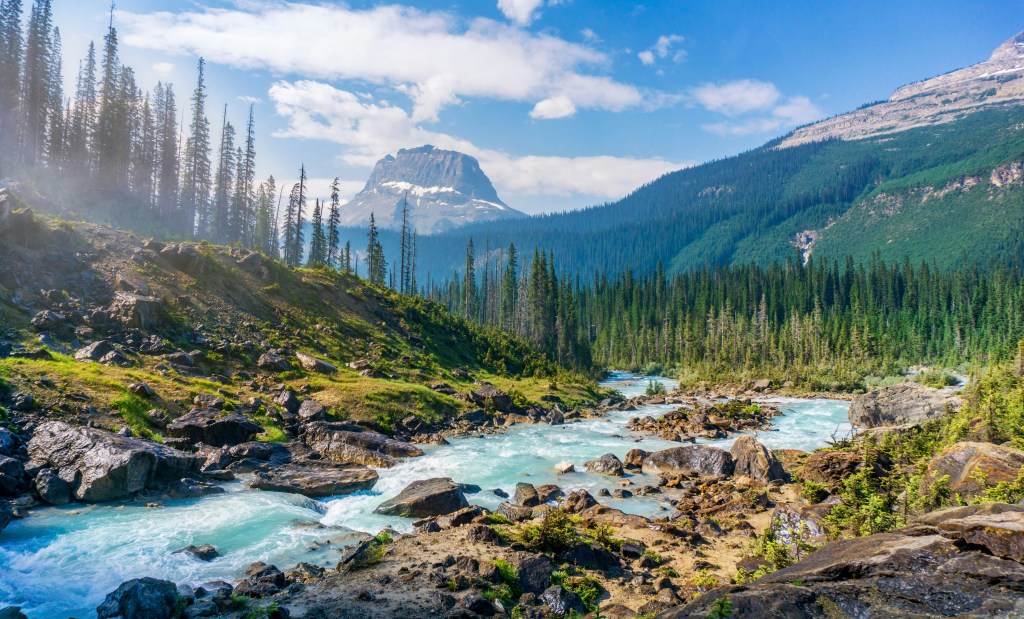
Earth is more than just a fact of life; it is more than a concern of environmentalists. Earth is our home—the one place we know of where life exists. Here, life thrives, and competes, and cooperates, and evolves, and so develops immunities and other abilities attuned to endurance. Earth is the living space for all of the kingdoms and species we know of, for the life of the mind and of the soul, for our separate and interconnected personal projects of imagination and belonging.
It is common to treat “the environment” as something external to our personal or economic interests. We also tend to discuss “habitat” as something that animals need, while we go about creating our own. In both cases, we leave out the deep ecological reality of the living systems that allow us to exist and thrive.
The reality of our everyday existence is that our habitat, our ability to safely and reliably benefit as participants in Earth’s biosphere, is connected to and dependent on everything we might call the environment. This extends to planetary systems, atmsopheric chemistry, and fluid dynamics far beyond what we normally think of when we talk about sustainability.
Deep ecology is the structure of reality. What does this mean? It means we are vulnerable, and technocratic answers to existential questions fall short. We need science and discovery, and technology and innovation, to understand our world and to guard against danger, but that does not mean we will easily accept that a particular research paper has identified how we should live our lives.
It also means that complexity is the underlying factual framing for all of our decisions, no matter how straightforward. As noted in the recent Active Value report on deep ecology:
When we parse the data from the Whole-Earth Active Value Economy (WEAVE) knowledge graph, a startling fact jumps out: Just 14 dimensions of sustainability and resilience knowledge and action contain 87.1 billion potential permutations—recombinations of the underlying categories, or variations of complex interrelationship. Adding an institution to the mix, as a 15th dimension, yields 1.31 trillion permutations… Adding in four more dimensions to the WEAVE experiment, to ground the quest for resilience knowledge and adaptive capacity in our local experience, gives us 121.6 quadrillion permutations.
This relational complexity is a positive thing; it is why life on Earth exists and has persisted for billions of years. It is why our planet has oceans and ice caps, mountain glaciers and watersheds, awe-inspiring biodiversity, and a relatively stable climate. The relational complexity creating conditions for life on Earth goes far beyond this very specific fabric of localized health and resilience.
Ecological complexity—including not only biological diversity but also geographical range and the diversity of inputs like fresh water, reliable seasonal climate patterns, and the effects of ecological migration patterns—helps to create conditions for health and resilience of natural systems. Only with sufficient complexity, across multiple interacting dimensions, can ecosystems embody both competition and symbiosis.
We are not only what we see and know, and part of the groups that we favor and trust. As Jane Goodall showed us, individuals of other species can feel deep, personal appreciation and affection for human beings, when we recognize the common threads in them, when we treat them as dignified individuals, when we recognize our shared experience as Earth-bound life-forms. Each of us plays a part in the life of the whole; we have impacts on others, and their activities affect us as well.
Science has revealed that the complexities we depend on extend far beyond local conditions or even the Earth system itself. The planet Jupiter has helped clear our planet’s path of dangerous rocky debris, and also helps to create a pattern of ice ages that can be graphed almost like a respiratory pattern. This has allowed life on Earth to evolve, persist, and thrive, to develop critical solutions to scarcity, and to exist in the wild diversity of forms we now see.
Dwelling on Earth—residing here, contemplating the irreplaceable good provided by natural systems, understanding the Earth system, and working to preserve it—requires us to embrace complexity and design systems that can leverage and reinforce beneficial natural complexities.
One quarter of the way through the 21st century, it is common to say that we should be past the difficulties and degradations of historical experience, that we should know the answers to complex questions and be able to cooperate to solve existential challenges. In many cases, we do have solid answers and workable solutions, but political and cultural barriers continue to block progress.
Have you, for instance, paused to contemplate the fact that the Preamble to the Constitution of the United States commits to “establish Justice” and calls on all of us to work for the benefit of future generations? Have you ever discussed with anyone, whether like-minded or not, that the Bill of Rights prohibits any and all acts of cruelty by government, even barring any arbitrary act of imposed power, without evidence and judicial review?
Some of the tools we have are common sense:
- Laws that restrain the powerful first of all, because they can do more harm to more people, are already established.
- The instruments of self-government are designed (and committed) to advance scientific exploration and discovery.
- The First Amendment not only recognizes the foundational freedoms of speech, religion, reporting, and assembly, but also the irreducible right to seek legal redress for injustice.
- A free society is organized to pursue evidence, to share insight, to lift everyone up from an undignified bondage to chaos.
In his own ‘Dwelling on Earth’, the Chilean poet Pablo Neruda asked “what gives rise to that surging of doves that stands between time and the night, like a dewy rift?” He answered the question with a stark meditation, suggesting the answer is “That sound now so long falling as it indexes the roads with stones, or rather, when only an hour grows without warning, stretches on without remorse.”
In other words, what separates the flow of time from the stillness of mindful reflection is not only the lyrical beauty of a flock of birds in flight, or the way witnessing it steeps our attention in the fluid dynamics of the living world. It is also the way in which a time of great change and consequence can seem frozen, dragging on, not allowing positive change to come in time to prevent further suffering.
We are living through a time in which we should be overcoming the cruelties, excesses, and ignorance of our deep history. We have laws and institutions, science and technology, cooperative structures, and a formal commitment to justice and to future generations. We know that human rights and ecological balance are compounding reinforcements of freedom and progress.
But the hour grows and stretches on without remorse. The space of this moment of change—instead of being a quick burst of illumination—is more of a far-reaching look at our many collective flaws. This has given rise to an industry of rage profiteering, where social media platforms lure people into heated interconnection through viral moments of shock and disbelief.
Dwelling on Earth can be so much more than that. It can be our window into the emerging future, a way of carefully witnessing what has value for and in one another, and a shared project of balancing competition and symbiosis, so that we are smarter than our flaws and able to not only talk about, but to live our ideals. The first thing is to recognize that none of us knows everything, nor should we.
Complexity is the nature of the fabric of life; it is the great teeming, colorful gift of Earth. Let’s embrace complexity; let’s recognize that ripple effects are opportunities for learning and for do-gooding, which means they are levers of empowerment, to make ourselves, and our communities, the industries of our time, and our vision of the future, more capable, more durable, and more liberating.
 Joseph E. Robertson, III